Look, I don’t go around trying to find reading challenges. I don’t need a reading challenge: I love to read! But here’s the thing: if I get a reading challenge bee in my bonnet, sometimes I just can’t restrain myself. Like, every year that I go to the Savannah Book Festival, I tell myself that I don’t need to feel obligated to read a bunch of books in preparation. But then I am just so nerdy that I want to learn a little more about the authors, and then I have to read a sample of books, and then the schedule comes out and I have one time slot when I can’t decide which author’s talk to attend, and then I have to read a couple just to see. It’s honestly almost a problem because I have other things to do with my life!
I don’t know how I missed it in January through May, but I have recently become aware of the America’s 250th Birthday Reading Challenge. People are creating templates and finding templates and asking other people for suggestions about how to fulfill their reading challenges. A lot of these templates look the same, the same challenges, with people sharing how they’ve filled them in. There’s a page 2 that someone made of which I am not a particular fan. There’s another template that’s more focused on trying to be well-rounded with representation of all different types of people. Do a quick search and you’ll see that there’s a ton of suggested books.
And I am such a nerd that I am taking notes on all of them. You know how it is: you linger on a Facebook post, and next thing you know, it’s taken over the algorithm (better than the time I started getting all gross recipes, at least). So I’ve been saving pictures of all of these filled templates and creating a massive list of all the books I should read. It’s a big list.
And I thought about sharing this massive list, but the truth is that I don’t want to go around recommending books that might not be so good. And I am a snob, so sometimes I look at people’s filled-in templates, and I’m like, “that whole book happens in England,” or “that book’s about civil rights, but it doesn’t take place in the Civil Rights era.” I am a nerd and a snob.
But more than either a nerd or a snob, I am a book lover. And as I was creating my “to read” list, I noticed that some were books that I’d already read, and, even better, some of the books were fantastic. Maybe, I thought, I could fill in a template to share that includes only books that I have read and I can strongly endorse.
And it was at this point that I lost hours of my life to an endeavor. I could not restrain myself.
First, I reviewed my used-to-be-Goodreads, now The StoryGraph list of books that I have awarded either four or five stars. I have a very specific star policy about books. A 5-star book is a book that I thoroughly enjoyed and learned something new. A 4-star book can be a book that I thoroughly enjoyed but didn’t particularly learn anything from or a book that I think was very good and I also learned something. I do not mark anything less than four stars. If I wouldn’t specifically recommend a book, I’m not going to give it a “meh” score because if you can’t say something very nice, don’t say anything at all.
I only took note of the books that I have read and definitely recommend and that take place in the United States and that are either historical fiction or nonfiction and that represent a specific time period as opposed to a survey over multiple generations. Disclaimers: there are exceptions to this rule, and this means that not every possible era is included and some eras are over-represented. You’ll see. In the process, I had to double check what period the various books took place, put them in a big list, and try to decide which books would make my template.
Ah, yes, and the template! I couldn’t find the official original source of any templates, and so I ended up creating my own. Which was its own little project. Did all of this take too much time? Yes, it did! But again, I could not restrain myself. I was hunched at my keyboard when I heard Cute W talking to the kitties about dinner. I paused to check the time and it was 7 pm! This had all taken over the entire afternoon, but I was on the home stretch. I’d come up with my list and now it was time to fill out my templates.
Some very good books did not make it onto the template. But I hate leaving out books that are great, so allow me to present you with four templates: two for fiction, two for nonfiction. Let’s go!
First, historical fiction from early US history…
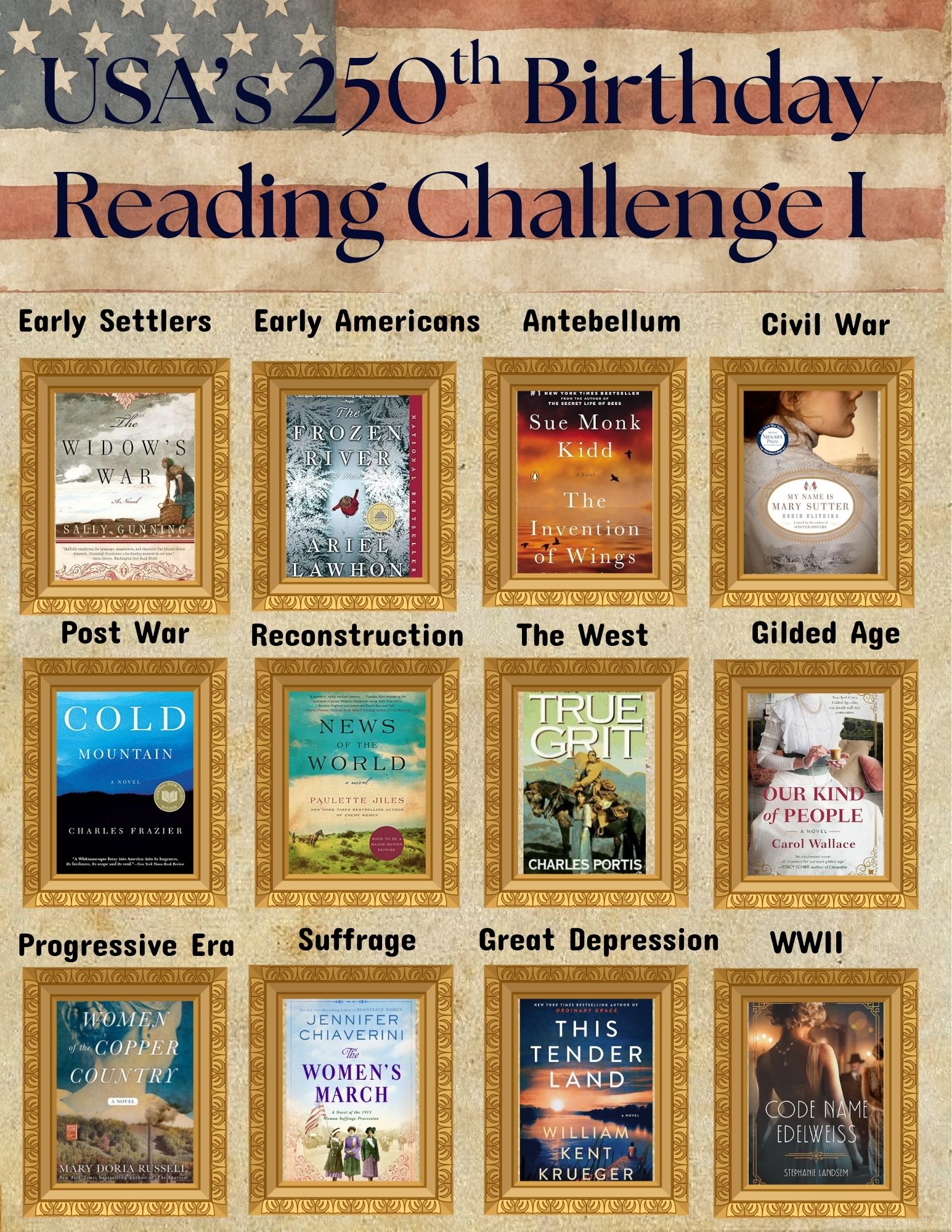
This was the toughest grid to pick, I think. The Great Depression is the setting for so many great books! I recently really enjoyed Kathryn Stockett’s The Calamity Club, I liked The Four Winds by Kristin Hannah, though I like other books she’s written better. Orphan Train by Christina Baker Kline was good, and I literally forgot about The Book Woman of Troublesome Creek by Kim Michele Richardson until just now, as I was writing this blog post. I’d never heard of the Blue People of Kentucky, so that was fascinating. For the American Civil War, I really enjoyed Gone With the Wind, but it is pretty darn racist, so I went with another one.
Among these picks on the template, Frozen River, The Invention of Wings, Cold Mountain, News of the World, and Women of Copper Country were 5-star reads for me.
Next, historical fiction from modern to contemporary history.
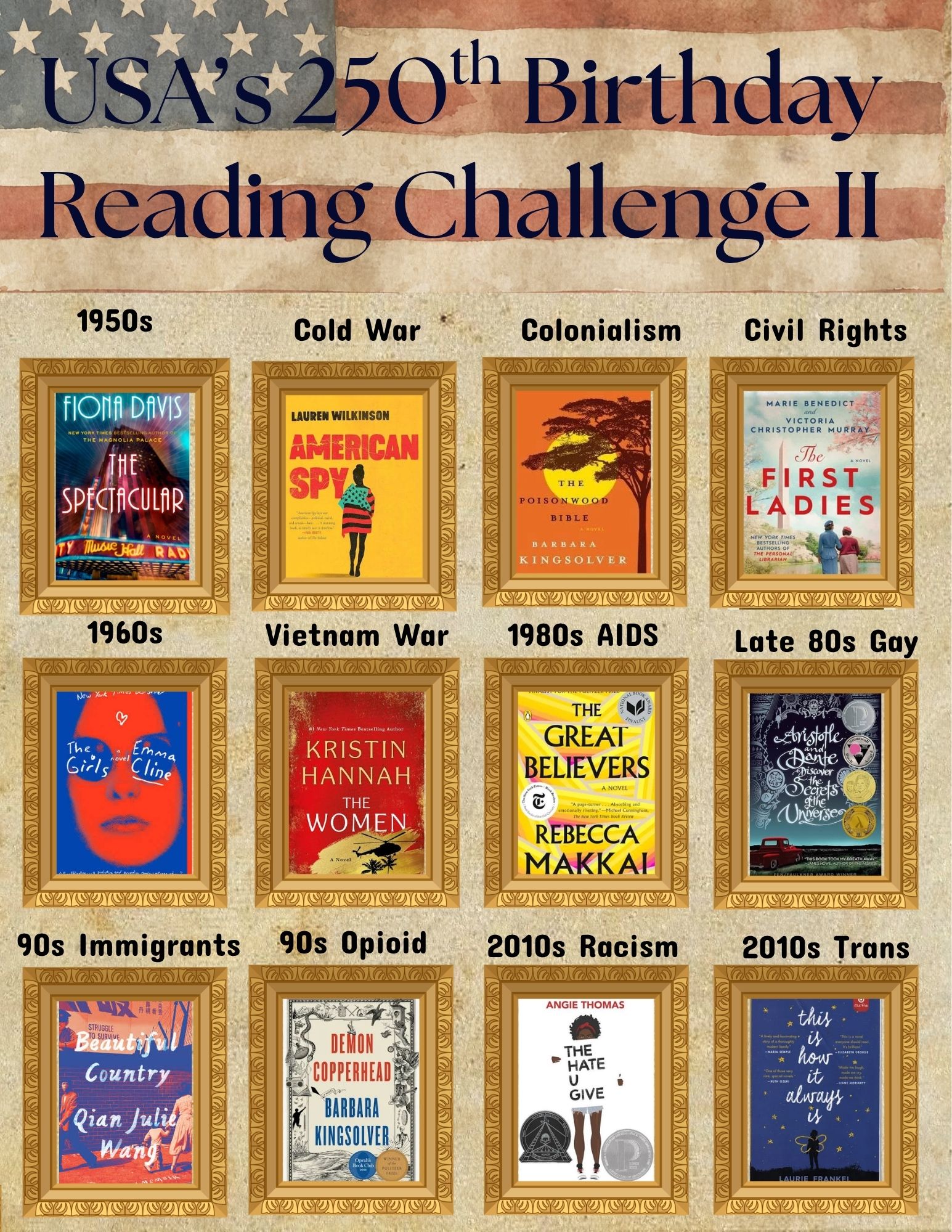
Okay, this template requires a couple of disclaimers. First, as we get closer to present-day, things get blurry: there are some books that aren’t necessarily written as historical fiction (meaning, written to portray a specific time period in the past), but that tell a story that is a specific time period and offers up a particular perspective than is not mainstream. In figuring out what to include, I chose books that I really enjoyed and that taught me something new about America or Americans.
The Poisonwood Bible is the only novel that doesn’t take place in the United States, but it’s the story of a Southern Baptist Family from Georgia in the Congo.
Among these, The Poisonwood Bible, The Girls, The Great Believers, Aristotle and Dante Discover the Secrets of the Universe, Demon Copperhead, and The Hate U Give are my 5-star reads.
As I was noting the historical fiction books that have taught me about the United States of America, I couldn’t help but notice that I had read a bunch of nonfiction books — especially a lot of memoirs–that are pretty great, too. For these picks, I specifically avoided big surveys of American history. There are a bunch of wonderful books, but I was going for books that feel as fun to read as novels. That’s a tough order for nonfiction, at least for me, so there are fewer personal 5-star reads, but still lots of great books.
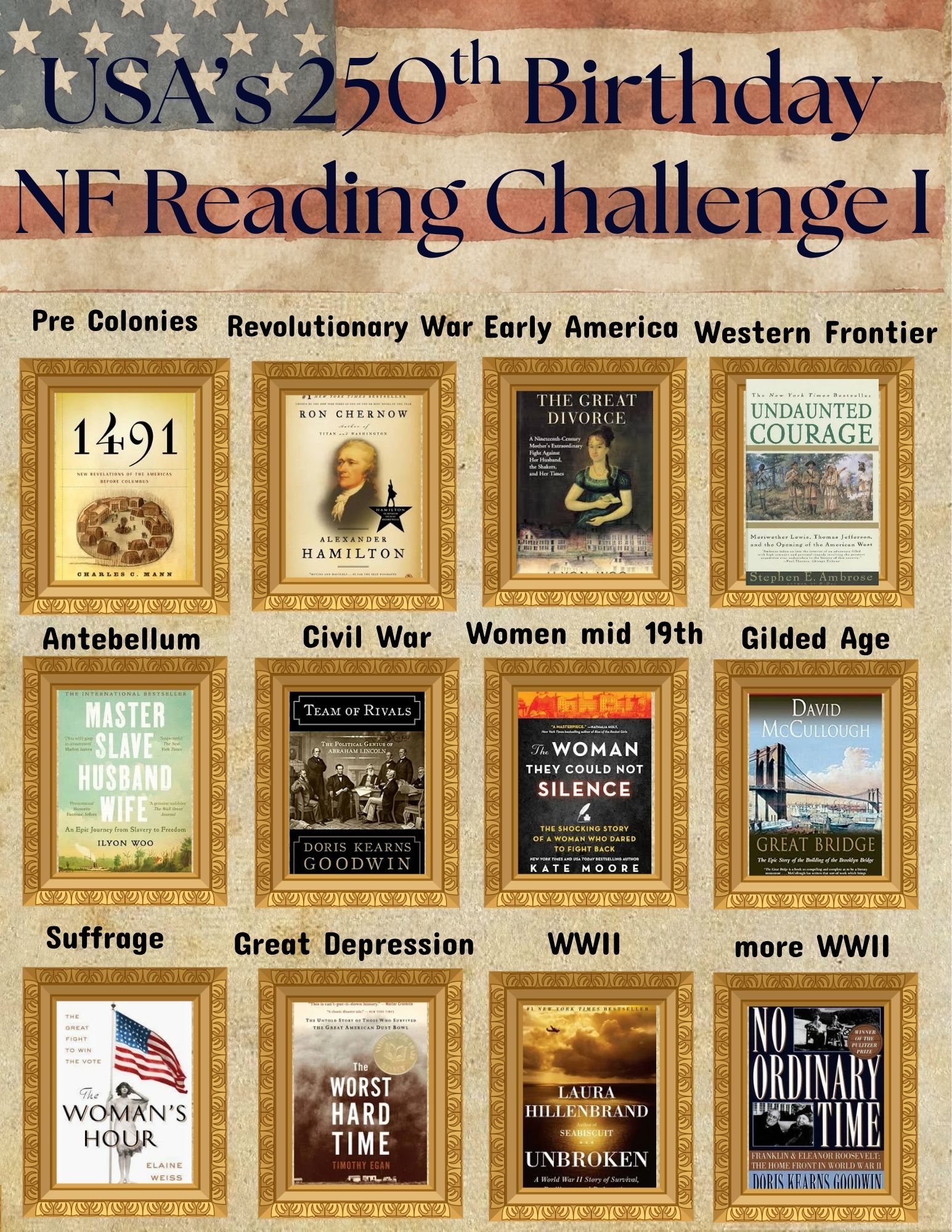
First, I didn’t choose The Boys in the Boat, by Daniel James Brown, for the Great Depression, and maybe I should have. It was a 5-star read, but when I was picking books, I was thinking about the personal drama and forgetting how much information there was about the (real-life!) characters’ economic troubles. I literally laughed and cried reading that book. But The Worst Hard Time is pretty awesome, too, and it feels especially relevant with the urgency of regenerative farming.
And once again, World War II has just spawned way too many awesome books. Did you see that I skipped World War I? Yeah, again, we’ve got to focus on what I’ve actually read. And pretty much everything I’ve read about WWI is Europe-focused. So it’s on the list for the future.
Of the books above, Master, Slave, Husband, Wife and The Woman’s Hour are 5-star reads. The first reads like a thriller, at least for the first half, and the latter inspired me to join the League of Women Voters.
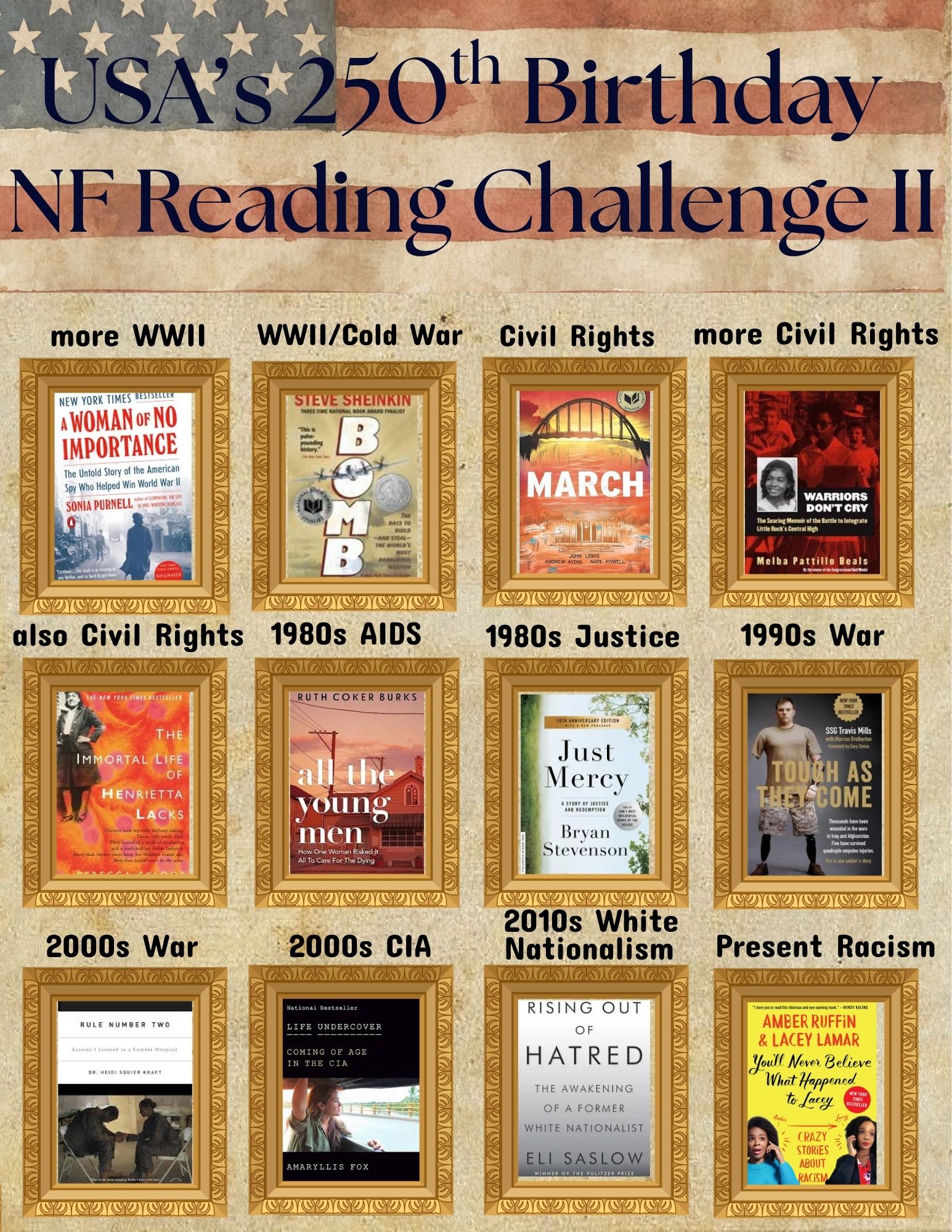
I told you that World War II was over-represented! And Civil Rights, too. Y’all: adversity breeds great literature. I also did the same thing as I did with the fiction section: as things get closer to the present, sometimes the books represent a specific topic in addition to or instead of a specific era.
Also: Bomb is a kids’ book, but it’s great and I learned from it. And March is the first of a graphic trilogy that together cover the Civil Rights era and the major players very well. You’ll Never Believe reads like one long gossip session that manages to be entertaining even while it’s appalling.
Bomb: The Race to Build — And Steal — The World’s Most Dangerous Weapon, March, Warriors Don’t Cry, Just Mercy, Life Undercover: Coming of Age in the CIA, and You’ll Never Believe What Happened to Lacey are all 5-star reads.
Now! I have a big ol’ TBR list, and right now I’m juggling a paperback and an audiobook, each historical fiction about characters heading toward North America in the 1660s. So if all goes well, maybe I’ll have a whole new template (or two, or three…) of favorite recent reads by the end of 2026.


Claire
This is great! I love historical fiction. I’m going to approach it not as a challenge, but as a list of book recommendations that I can refer to.
Katie
@Claire, what a normal, healthy way to approach it. I admire your restraint.
Nana in Savannah
I read so many of these books and appreciate your recommendations of others! I usually have three books going, one on audio for when I walk and drive, real book for cuddling at home and one on my kindle for waiting rooms or eating alone at home. Your layout of the books reminds me of when I was working on advertising layouts for the Savannah Book Festival. Your really pops and makes the book immediately recognizable. Thanks for all the work! Love you . . .
Claire
Normally restraint isn’t something I’m great at. But I’m good at it with book challenges because I still have PTSD from those stupid reading logs my son had to submit while in school. I felt like they turned reading into a chore rather than something fun. I love to read, and I want to keep it that way.
Katie
@Nana, aww, thanks!
@Claire, I hated those reading logs, too! One year we had a helluva time because the kids were supposed to do “partner reads” with a friend where two kids each read the same book to discuss. But J and her friend were such big readers that it was really hard to find something on their level and interesting that neither of them had already read. Super-annoying.